India’s digital ecosystem is growing faster than ever. With millions of customer interactions happening across websites, apps, POS systems, and messaging platforms, businesses are collecting and processing vast amounts of personal data.
To protect consumer privacy and regulate data usage, the Digital Personal Data Protection Act (DPDP Act) has introduced a new framework for how organizations handle personal data. For businesses, this means one thing: consent management is no longer optional, it’s mandatory.
Organizations must now build transparent, auditable, and purpose-driven consent systems. This is where OneConsent by Easyrewardz, an AI-powered CDP-Integrated Consent Management Platform (CMP), helps businesses simplify compliance and manage consent across all digital touchpoints.
What is the DPDP Act?
The Digital Personal Data Protection Act (DPDPA) establishes rules for how organizations collect, process, store, and manage personal data in India.
The act requires businesses to ensure that personal data is processed:
- Lawfully
- With explicit and informed consent
- For clearly defined purposes
- With traceable and auditable consent records
Organizations that fail to comply may face heavy penalties, making compliance a critical priority.
DPDP Penalties: Why Compliance Cannot Be Ignored
The DPDP Act includes significant penalties for violations, with fines that can go up to ₹250 crore, depending on the nature and severity of non-compliance.
These penalties highlight the importance of implementing a robust consent governance framework across the organization.
DPDP Implementation Timeline: Key Milestones
The DPDP framework will be implemented in phases, giving organizations time to prepare.
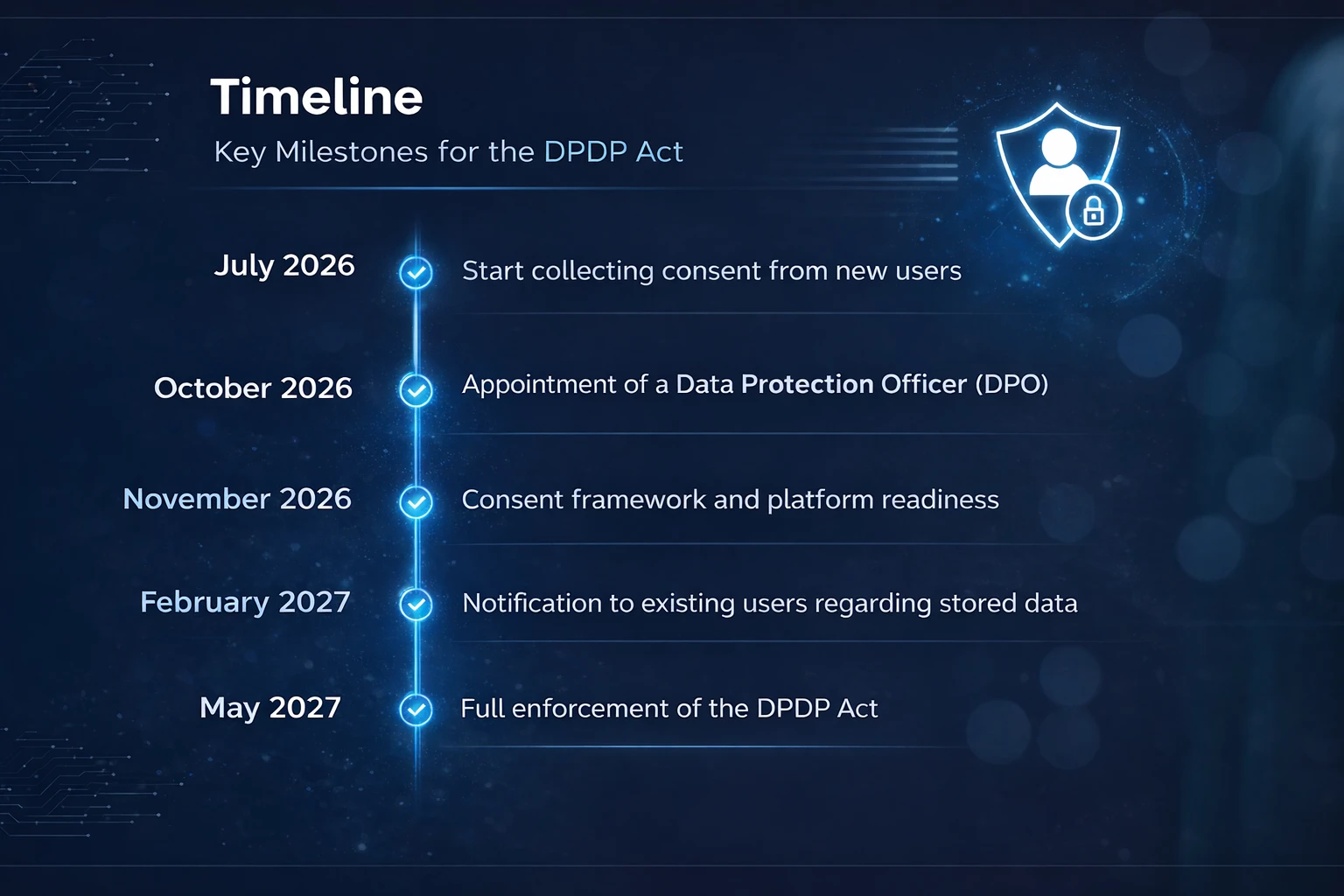
Organizations that begin preparing early will be in a much stronger position once enforcement begins.
The Shift from Implied Consent to Explicit Consent
One of the biggest changes introduced by the DPDP Act is the move from implied consent to explicit consent.
Previously, many organizations relied on privacy policies or terms and conditions to obtain consent. Under the DPDP framework, this approach is no longer acceptable.
Consent must now be:
- Explicit
- Purpose-specific
- Freely given
- Easily withdrawable
This means organizations must maintain systems that track when consent was given, for what purpose, and through which channel.
When Consent is not required
The DPDP Act allows certain scenarios where data can be processed without explicit consent if it is necessary to deliver a service requested by the user.
Examples include:
- Creating a customer account
- Processing an order or payment
- Delivery updates and order tracking
- Customer support interactions
- Tax and compliance requirements
However, this legitimate use cannot extend to marketing or advertising activities.
When Explicit Consent Is Mandatory
Explicit consent is required when personal data is used for purposes beyond service delivery.
Examples include:
- Marketing communications
- Promotional campaigns
- Behavioral profiling
- Targeted advertising
- Sharing data with partners or vendors
- Cross-platform tracking
This makes granular consent management systems essential for modern businesses.
The Biggest DPDP Challenge: Fragmented Consent Systems
Most organizations today operate across multiple digital platforms:
- Websites
- Mobile applications
- CRM systems
- POS systems
- Loyalty programs
- Marketing automation platforms
- Third-party vendors
This results in fragmented consent records across systems, leading to challenges such as:
- Lack of unified consent visibility
- Complex integrations between systems
- Difficulty in maintaining compliance
- High operational and audit costs
To overcome this complexity, organizations need a Singular consent management approach
OneConsent by Easyrewardz: A Unified Consent Management Platform
OneConsent by Zence is designed to help organizations implement a centralized consent management framework aligned with DPDP compliance.
It acts as a single source of truth for consent data, ensuring that all applications and platforms operate with the same consent information.
Key capabilities include
Centralized consent management
A single platform that manages consent across websites, apps, POS systems, CRM platforms, and communication channels
Real-time consent synchronization
Any change in consent preferences is instantly reflected across connected systems.
Multi-channel support
Integration with channels such as web, mobile apps, SMS, WhatsApp, IVR, POS & more…
Audit-ready consent records
Every consent action is logged, ensuring organizations remain ready for regulatory audits.
Building a DPDP-Ready Data Ecosystem
Before implementing a consent platform, organizations must understand their data landscape.
This discovery phase focuses on three key questions:
What data is collected?
Organizations must identify all customer data types including personal data, behavioral data, and transaction history.
Through which touchpoints?
Data may be collected through multiple channels including apps, websites, POS systems, loyalty programs, and CRM platforms.
Why is the data collected?
Each dataset must be mapped to a specific purpose such as marketing, analytics, personalization, or compliance.
This structured discovery approach ensures that consent aligns with data usage purposes.
Compliance as a Business Advantage
While DPDP compliance may initially appear complex, organizations that adopt a structured consent strategy gain several long-term benefits.
Stronger customer trust
Transparent consent controls build credibility with users
Better marketing performance
Purpose-based permissions improve data quality and campaign effectiveness
Reduced regulatory risk
Audit-ready records help organizations avoid penalties
Privacy-safe personalization
Consent-driven segmentation enables compliant and effective customer engagement
In the long run, data privacy becomes a competitive advantage rather than a regulatory burden.
Preparing for the DPDP Era
Organizations should start preparing now to avoid compliance challenges later.
Key steps include:
- Mapping all data touchpoints
- Identifying data processing purposes
- Reviewing vendors and integrations
- Training teams on DPDP responsibilities
- Deploying a consent management platform
- Conducting compliance readiness tests
Early preparation ensures businesses are ready for the May 2027 DPDP enforcement deadline.
The DPDP Act represents a major shift in how businesses handle personal data in India. Organizations must move from fragmented data practices to structured, consent-driven data governance.
A centralized Consent Management Platform like OneConsent by Easyrewardz enables businesses to simplify compliance, build customer trust, and manage consent across their entire digital ecosystem.
In a world where privacy defines brand credibility, consent management is not just about compliance, it is about building a future-ready data strategy.