Think about five different customers walking into the same store or landing on the same website. One’s a first timer, still deciding if she likes the brand. One’s been buying for years and spends more than most. One’s a loyalty member who never misses a sale notification. One hasn’t ordered anything in six months. One only ever shows up when there’s a coupon.
Send all five the same email, and you’ve basically wasted the send.
That’s really what customer segmentation is trying to solve. Not “more personalization” as a buzzword, just making sure the right message gets to the right person, so campaigns actually move the needle on conversion, repeat purchase, and retention instead of just going out into the void.
So, what does segmentation mean?
It’s tempting to reduce segmentation to spreadsheet filters age, gender, city. That’s not wrong exactly, it’s just not enough. The real question segmentation answers are about intent: who’s close to buying right now, who needs a reminder, who’s quietly checking out mentally, who’s earned something for their loyalty, and who has seen one too many “20% off” banners already.
What this looks like in a retail context
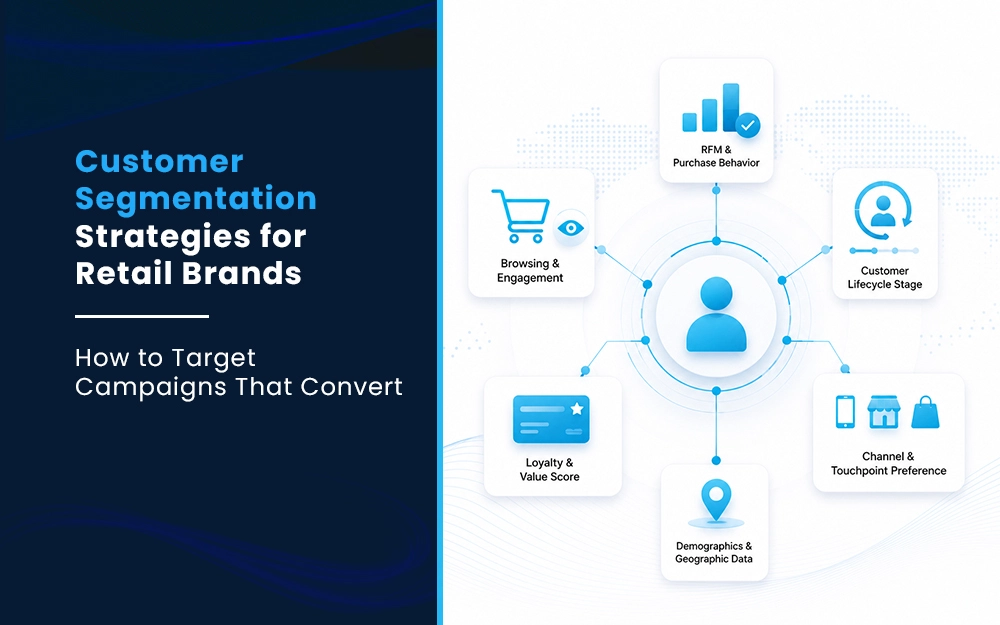
In practice, retailers segment on purchase history, browsing behaviour, loyalty activity, how people engage with campaigns, which channels they respond on, and where they are in their relationship with the brand.
Demographics and location still matter, to be fair. If you’re opening a new store, you’d target people nearby. If you sell winter coats, colder cities make sense first. Festive campaigns get localized by region all the time. Fine , but that’s the easy part.
Behaviour tells you more. Someone buying the same skincare product every 45 days has basically told you their replenishment cycle without saying a word. A loyalty member sitting on unredeemed points is one nudge away from a purchase. Someone who’s opened the same product page three times and still hasn’t bought? That’s not indecision, that’s interest waiting for a reason. And someone who hasn’t bought in six months —, that’s a brand quietly losing a customer, whether anyone’s noticed yet or not.
Why sharper segmentation matters more in retail specifically
Retail customers don’t move in straight lines. Someone might scroll through products on their phone during lunch, walk into the store on Saturday, redeem a coupon at checkout, get a WhatsApp promo two weeks later, then finally buy online. Every one of those steps is a data point.
The problem most retailers run into isn’t a lack of data —, it’s that the data doesn’t talk to itself. Purchase history sits in one system. Loyalty points live in another. Campaign clicks get tracked somewhere else entirely. Store transactions and online behaviour often don’t even know about each other.
The result is predictable: a big spender gets the same 15%-off code as someone who bought once and vanished. A customer starts drifting and nobody notices until it’s too late to win them back. A loyalty member never gets told they have points sitting there. Everything goes out, but none of it feels like it was written for anyone in particular.
Fixing this isn’t complicated in theory , it’s about connecting the data you already have to the decisions your campaigns make.

The segmentation strategies that actually earn their keep
1. RFM , recency, frequency, monetary value
If you only do one type of segmentation, it’s probably this one, because it maps almost directly to revenue.
Recency: when did they last buy. Frequency: how often do they buy. Monetary: how much do they typically spend. Put those together and you get a much clearer picture than “customer bought a shirt in March.”
Someone who bought last week, buys constantly, and spends well shouldn’t get lumped in with someone who made one purchase a year ago and disappeared. The first person might respond well to early access or a VIP touch. The second one probably needs an actual win-back offer, not another generic newsletter.
RFM also saves brands from two pretty common traps: discounting customers who were going to buy anyway and letting genuinely valuable customers quietly slip away because nobody flagged them in time.
2. Behavioural segmentation —, what people do, not who they are on paper
This one’s built on actions: what got bought, what got browsed, what sat in a cart, which offers got used, which emails got clicked, which stores got visited, what got returned.
A beauty brand can catch someone who reorders moisturizer every month and send the reminder right before they’d normally run out. A fashion brand can go back to shoppers who looked at the festive collection twice but never checked out. A grocery brand can build recurring baskets around whatever people restock every few weeks. A shoe brand can chase down an abandoned cart before the shopper forgets it existed.
None of this requires guessing. It’s just paying attention to what already happened.
3. Lifecycle segmentation , meeting people where they are
A stranger becomes a browser. A browser becomes a first-time buyer. A first-timer, if things go well, becomes a repeat customer, and eventually a loyalist. And sometimes , often, honestly , a loyalist just goes quiet for no obvious reason.
The point of lifecycle segmentation is not treating every stage the same. A new lead probably needs to understand the brand before they need a discount. A first-time buyer wants to feel welcomed, maybe introduced to the loyalty program. A repeat buyer likely wants recommendations, not another generic pitch. Someone who’s gone dormant needs something different again , a reason to come back, not a reason to unsubscribe. And a genuinely loyal customer usually just wants to feel recognized.
4. Loyalty-based segmentation
Group people by tier, points balance, how often they redeem, whether they refer friends, how frequently they visit. Someone with a pile of unused points just needs a reminder those points exist. Someone one purchase away from the next tier might just need a small push. Your top-tier members deserve to feel like top-tier members , early previews, better perks, less generic treatment.
This is really about weaning off constant discounting and replacing it with something that feels earned instead of desperate.
5. Channel-based segmentation
Some people live on WhatsApp. Some barely check it and open every email instead. Some respond fastest to a plain text message. Others basically only engage in-app.
A flash sale probably belongs on SMS or WhatsApp , it’s urgent, it needs to be seen now. A thoughtful product recommendation might land better in an email someone can actually sit with. A loyalty update could go either way depending on the customer.
The goal, stripped down, is just: right customer, right message, right time, right channel. Easy to say, harder to do without the data to back it up.
Where this actually shows up in campaigns
Segmentation only matters once it changes what a campaign looks like. For repeat purchase, that means giving first-time buyers recommendations or a proper loyalty welcome instead of a blanket newsletter. For win-back efforts, it means treating a dormant high-spender very differently from someone who bought once on a whim.
For protecting margin, it means discount-driven shoppers get the sale alerts and bundle deals, while your best customers get early access and exclusivity instead of yet another coupon. And for festive campaigns, layering in someone’s past festive purchases, category interest, region, and preferred channel makes the difference between an offer that feels considered and one that feels copy-pasted to the whole database.
How Easyrewardz and Zence fit into this
None of this works if the data stays scattered. If purchase history, loyalty records, campaign engagement, and store transactions all live in separate silos, you end up with segments that are only half-true.
That’s the gap Zence is built to close. Easyrewardz already works in customer engagement, loyalty, and CRM for retail. Zence pulls those pieces into one connected system, so brands get a fuller picture of each customer instead of fragments.
Zence 360 Segmentation lets brands build segments out of purchase history, browsing behaviour, campaign engagement, demographics, custom tags, and customer actions —, then actually push those segments out across email, SMS, WhatsApp, and chat. Practically, that means a brand can spot its dormant high-value customers and run a win-back sequence, catch loyalty members with unused points, build category segments straight from what people have bought, and watch how each segment performs over time instead of guessing.
The segments themselves aren’t really the win. The win is what happens after , communication that actually reads as relevant to wherever that customer is.
A few mistakes worth avoiding
Treating segmentation as a one-time list-building task is probably the most common one. A segment should be doing something , shaping the message, the offer, the timing, the channel , not just sitting there as a filtered export.
Leaning too hard on demographics is another. They’re a decent starting filter, but they don’t tell you much about what someone’s actually going to do next.
Ignoring offline data is a quieter mistake, but a costly one for brands with physical stores , POS purchases and in-store loyalty activity are just as telling as anything that happens on a website.
And sending everyone the same discount, regardless of who they are, kind of defeats the purpose of segmenting in the first place.
Bottom line
Good segmentation isn’t about slicing customers into neater boxes for the sake of it. It’s about noticing what recency, frequency, spend, behaviour, lifecycle stage, and channel preference are actually telling you —, and using that to send fewer, better-timed messages instead of more generic ones.
With Zence 360 Segmentation by Easyrewardz, retail brands can pull that scattered data together, build segments that mean something, and run campaigns around the right audience, the right message, and the right moment , instead of just hoping the blast lands.
Frequently asked questions
Grouping customers by purchase history, behaviour, loyalty activity, lifecycle stage, location, or channel preference —, so campaigns feel relevant instead of generic.
It sorts customers by recency, frequency, and spend, which separates high-value and loyal shoppers from dormant or one-time buyers , and tells you who actually needs a different kind of message.
It builds segments from purchase history, browsing behaviour, campaign engagement, demographics, custom tags, and customer actions, then activates them across email, SMS, WhatsApp, and chat.