Loyalty program conversations often begin with mechanics: points ratios, tier names, reward catalogues. Those decisions land better once a more fundamental question has been answered: which customer behavior do you want this program to influence, and how will you know whether it is working?
What Is a Customer Loyalty Program?
A loyalty program is a structured way to recognize and reward repeat engagement, usually through points, tiers, or benefits tied to purchases and other actions you want to see more of. The objective is to give a customer a reason to stick around past the first transaction, and give your business a consistent way to understand that relationship as it develops.
Loyalty as Part of Your Customer Data Strategy
A loyalty program generates a specific kind of information: what customers buy, how often they show up, which rewards land, and which channels they use to reach you. On its own, that tells you how the program is performing.
Purchase and engagement signals from loyalty can shape segmentation, personalization, and marketing decisions well beyond the program itself. That is the case for treating loyalty data as customer data, fully connected to the rest of the CRM.
The Business Case
The first transaction is a foundation for everything that follows. Every interaction after it gives you another chance to understand preferences and build something that feels relevant instead of generic. The commercial case gets made through metrics that matter to your business: repeat purchase, retention, customer value, and program economics, all of which get easier to define once you look at loyalty through the customer funnel.
The Customer Funnel Behind a Loyalty Program
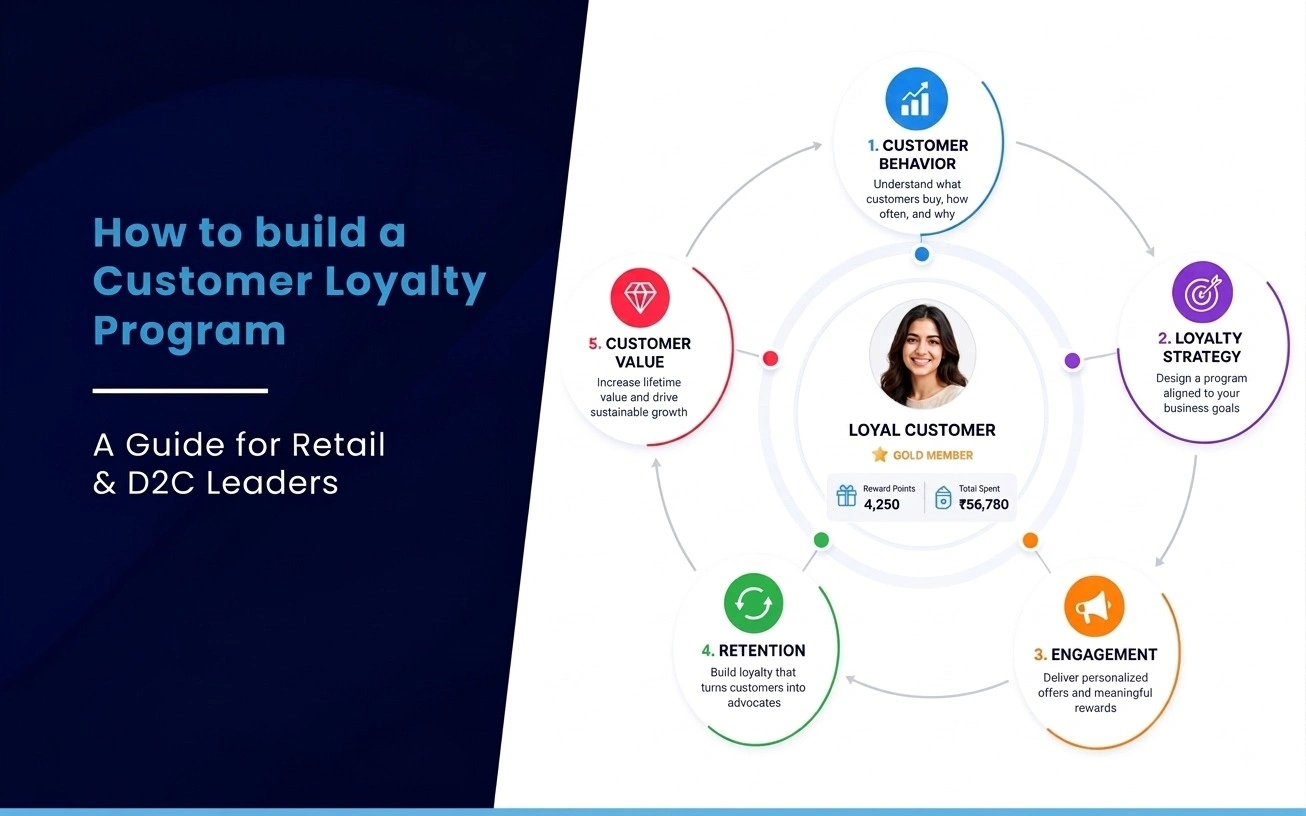
Loyalty gets discussed as though it only touches repeat purchase. In practice, it runs through several stages at once, and mapping what to measure at each one clarifies what your program needs to do.
- Acquisition: which sources bring customers who go on to engage repeatedly
- Enrollment: how many customers join, and where that moment sits in the journey
- Engagement: whether members are participating or enrolled without engaging
- Purchase and repeat: whether the program shapes buying behavior and turns single visits into a pattern
- Retention: how member behavior compares with prior activity over a longer window
- Customer value: lifetime value calculated across the full relationship, spanning every transaction a member makes over time
Reward cost, redemption rate, and program ROI run alongside all of this as their own measurement layer, and together they determine whether the program is financially sustainable.
Types of Customer Loyalty Programs
| Program Type | How It Works | Typical Fit |
|---|---|---|
| Points-based | Earn points per rupee spent, redeem for rewards or discounts | Frequent, moderate-value purchases |
| Tiered | Status levels unlock better benefits as spend or engagement grows | Differentiating high-value customers |
| Paid or VIP membership | Customers pay for immediate, defined benefits | A clear value proposition beyond discounting |
| Gamified | Spins, badges, and milestones add an interactive layer | Younger, digitally active audiences |
| Hybrid | Points-based earning combined with tiered status | Broad customer base, varied purchase occasions |
Purchase frequency, margin structure, and the behavior you want to influence should decide which of these fits, which is why this choice works best once the funnel work above is settled.
Key Decisions in Building the Program
- Define the behavior you want to influence. Decide which stage of the funnel matters most right now, then choose a consistent way to measure it.
- Understand your customers first. Look at what separates your highest-frequency customers from occasional buyers, which categories drive the bulk of transactions, and where purchase activity happens most.
- Choose the model that fits your business. Points support repeat purchasing, tiers introduce differentiated recognition, membership works where customers value a defined set of benefits upfront.
- Design the earning structure around that behavior. Weight the program toward frequency, category adoption, or customer value, whichever matters most, and build in enough flexibility to manage rules across segments and channels.
- Give the reward catalogue real variety. Discounts, vouchers, products, and experiences each appeal to different customers, and redemption rules keep the program’s economics predictable.
- Plan for personalization and engagement. Purchase history and engagement patterns can shape what each customer sees instead of one offer for everyone.
- Evaluate your technology against what the strategy needs. Look for a flexible rules engine, consistent recognition across channels, a real connection to your broader customer data, and reporting that updates on its own.
- Plan enrollment, then stay visible. Decide where enrollment fits most naturally in the journey, and treat communication as an ongoing part of the marketing calendar.
- Measure and refine on a set cycle. Track enrollment, active member percentage, redemption rate, and return on investment together, and use what you see to keep the program aligned with how customers behave.
The Technology Behind a Scalable Loyalty Program
A loyalty strategy needs technology that can execute it at scale. As programs grow across channels, customer segments, and engagement journeys, brands need flexible loyalty rules, a unified view of customer activity, and the ability to personalize engagement based on behavior. Real-time reward and redemption management sits at the center of all three.
Zence Loyalty Management, part of the Zence CRM suite powered by Easyrewardz, gives brands the tools to build and manage loyalty programs around these requirements. Brands configure earning and redemption rules across purchases, categories, channels, and customer tiers, and manage rewards and customer engagement from a single platform. A customer’s earn and redemption history sits inside the same profile used by marketing, service, and commerce teams. A purchase made in one channel updates the same record a service agent sees, and the same record a marketing team pulls for the next campaign.
Loyalty data connects with customer, marketing, service, and commerce data across the broader Zence CRM ecosystem. Brands use purchase and engagement behavior for segmentation and personalization outside the loyalty program itself, so loyalty functions as a connected part of the full customer relationship. Zence also includes AI capabilities that read purchase history and engagement patterns to help determine which reward or offer suits a given customer. A marketing team configures the logic once, and it applies automatically across every segment.
Retail, D2C, F&B, and BFSI brands in India run Zence, including Bata, Titan, Skechers, Levi’s, Flipkart, and Burger King. These deployments cover different program structures and customer bases, and together they demonstrate how the platform supports varied loyalty models across industries.
Conclusion and Next Steps
Building a loyalty program is a sequence of connected decisions, starting with the behavior you want to influence and ending with how you measure it. The strongest strategies connect every decision in between back to the customer relationship you want to build and the value you want to measure.
If you are evaluating your own strategy, the Zence team can map your funnel, requirements, and technology environment against what would support it. Explore Zence Loyalty Management or request a demo to see how it applies to your goals.
Frequently asked questions
Defining which customer behavior the program needs to influence, before any reward mechanics get designed. Every later decision traces back to this one.
There is no single model that fits every business. Purchase frequency, margins, and the behavior you want to influence determine the choice.
Yes, provided the platform recognizes a customer consistently across channels in real time, so a points balance never looks different depending on where someone shops.
That depends on the complexity of the program and the number of channels involved. A simple program can run on limited technology. A connected strategy spanning multiple touchpoints generally needs a dedicated platform.