There’s a specific kind of frustration that shows up in retail analytics meetings. Someone has the sales dashboard open. Someone else is in the CRM. A third person has loyalty data in a separate tab. And then the question lands: “Why did repeat purchases drop after we ran that service campaign last quarter?”
Silence. Not because the data doesn’t exist — it does, scattered across five systems — but because nobody can pull it into one answer fast enough to be useful.
That moment? It’s not a data problem. It’s a structural problem. And it’s far more common than most retail brands would openly admit.
Everyone has Data. Nobody has the full picture
Let’s be honest about what’s actually happening inside most retail organizations right now.
The sales team has one version of the customer. Marketing built a different profile from campaign interactions. Loyalty tracks purchase frequency but misses the browsing behaviour upstream. Store operations can see transaction history but nothing about what led someone there. Customer support has complaint logs but no idea if the person filing a ticket is a first-time buyer or someone who’s spent ₹2 lakhs with the brand over three years.
Every team is working from a fragment. And the customer — the actual human being on the other side — doesn’t experience any of this as fragments. They experience it as one brand.
When someone browses your website on Wednesday, visits your store Friday, files a complaint the following Tuesday, and then gets a promotional email Thursday that has nothing to do with any of that… they feel the disconnect. Even if they can’t articulate why, something feels off. The brand doesn’t seem to know them.
That gap — between how customers experience a brand and how the brand actually sees that customer — is precisely what omnichannel CRM is designed to fix.
What “Omnichannel CRM” Actually Means
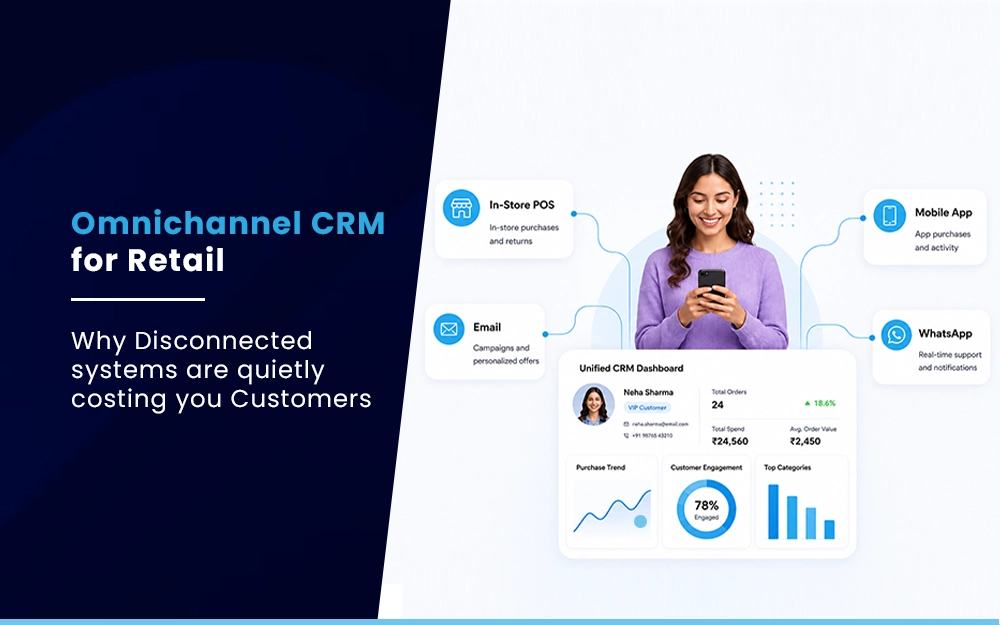
An omnichannel CRM connects every channel a customer touches — ecommerce, physical stores, loyalty programs, support platforms, WhatsApp, in-store billing — into a single, continuously updated customer profile.
Not a synced report. Not a weekly data dump. A live, unified view of who this customer is, what they’ve done across every channel, and what they’re likely to need next.
The distinction from traditional CRM isn’t just technical, it’s philosophical. Traditional CRM was built to record interactions. Omnichannel CRM is built to understand people.
That sounds like a small shift until you’re sitting in a room where someone asks why a customer who shopped with you loyally for four years suddenly went quiet — and nobody can pinpoint when or where it started.
Why Traditional CRM was never built for this
Traditional CRM made complete sense when retail was simpler. Customer comes in, buys something, record gets updated, interaction closes. Clean and linear.
That’s not retail anymore.
Today, a single purchase decision might touch eight or ten different touchpoints before it converts. Someone spots a product in an Instagram story. Searches for reviews. Adds it to their app wishlist. Visits a store to check the fit in person. Asks a question over WhatsApp. Buys it online two days later because a discount code showed up in an email.
One customer. One purchase journey. But inside most retail tech stacks, that’s six or seven disconnected data points living in completely separate systems — because nobody planned it that way. It just accumulated, tool by tool, as the business grew.
Marketing owns one platform. Support owns another. Loyalty runs on a third. Commerce teams live somewhere else entirely. The result is fragmentation that makes it genuinely hard to retain customers, personalize meaningfully, or catch churn before it happens.
A Real Journey that still breaks most systems
Here’s a scenario that isn’t unusual at all.
A customer clicks through a Facebook promotion, browses, adds things to cart, and leaves without buying — something came up. A few days later, she walks into a nearby store and buys the same product in person. While checking out, she signs up for the loyalty program. Two weeks later, she contacts support about a product defect. The issue gets resolved. She fills out a feedback form.
Completely ordinary. Modern retail in every sense.
Now here’s what most CRM environments actually captured from that journey:
- Marketing sees an abandoned cart and an online non-conversion
- Store staff see a transaction with zero prior context
- Loyalty sees a new member with no behavioural history attached
- Support sees an incoming complaint with no purchase or loyalty data visible
- Feedback team sees a sentiment score sitting in complete isolation
Five teams. Five data points. Zero connected view of one person’s experience.
Multiply this across tens of thousands of customers, and you lose something critical — the ability to identify patterns. The customers who are quietly drifting. The segments responding to one channel but not others. The service failures that are eroding loyalty without a single alert being triggered.

What actually shifts when the Data Connects
When a retail brand genuinely moves to omnichannel CRM — not a legacy CRM with a few APIs bolted on, but a system where the data model is built around unified customer profiles — three things change in a meaningful way.
Visibility becomes real. A store associate can see that the customer in front of them raised a support issue last week that hasn’t been resolved yet. That one piece of context changes the entire interaction. Without it, the associate is flying blind. With it, they can acknowledge the situation, show empathy, and turn a potential walkout into a moment of genuine recovery.
Timing gets sharper. Retention efforts work better when they’re triggered by actual behaviour signals rather than calendar schedules. A customer who visited twice a month for six months and then went quiet is a fundamentally different situation from a one-time buyer who never returned. Omnichannel data lets you see that difference — and act on it before it becomes permanent churn.
Trust compounds over time. When customers feel that a brand actually knows them — not just in one context, but across channels — it changes the relationship. Personalization grounded in real behavioural history feels considered. Personalization based on a single transaction feels like guesswork. Customers know the difference, even if they can’t explain how.
The part nobody sees
Here’s something that tends to get skipped in most omnichannel CRM conversations: connecting the data is only half the work.
A unified customer profile sitting inside a platform nobody actually queries is expensive infrastructure with a good demo. The retailers getting real value from omnichannel CRM are the ones who’ve rebuilt their workflows around it — where store associates are trained to pull up customer history before a conversation, where campaigns are triggered by cross-channel behavioural signals, where support agents can see the full commercial picture of whoever they’re speaking to.
That’s a change management problem as much as a technology one. It requires buy-in from store ops, marketing, support leadership, and frankly anyone who touches a customer.
But the brands that solve both layers — the data model and the operational habits — end up with something competitors genuinely cannot replicate quickly: an accurate, real-time picture of their customers that most competitors are still trying to piece together from spreadsheets across four different systems.
Where Retail is heading (And Why This Gets More Urgent)
More channels are coming, not fewer. More touchpoints, more data generated per customer per day, more complexity in how people discover, evaluate, and buy. The brands that thrive in that environment won’t necessarily be the ones with the biggest technology budgets.
They’ll be the ones that figured out how to turn all that customer data into something coherent — and then actually did something useful with it.
The shift from traditional CRM to omnichannel CRM isn’t an upgrade. It’s a different way of thinking about what a customer relationship even is. And for brands still running fragmented systems, the cost of staying there is already visible — in churn they can’t explain, in retention campaigns that don’t land, in customers who feel like strangers to a brand they’ve been shopping with for years.
The data to fix most of this already exists. The real question is: is it connected?
Why Zence Unified CRM is built for exactly this problem
Most CRM platforms are horizontal — built for industries broadly, retrofitted for retail. Zence is different. It’s a vertical SaaS platform built for retail, which means the data model, the workflows, and the logic are all designed around how retail customers actually behave — not how a generic SaaS product assumes they do.

Zence consolidates what most brands manage across five separate tools — Lead Management, Loyalty Programs, Campaign Automation, Customer Data Platform, Feedback Management, and AI-powered Service Bots — into a single unified stack. No duct-taped integrations. No nightly syncs. One platform, one customer profile, updated in real time.
A few things worth knowing about what Zence actually does:
- Unified Customer Profiles that span online and offline — so a store associate sees the same customer history a support agent does
- AI-powered segmentation that goes beyond demographics into actual behavioural patterns, buying cycles, and channel preferences
- Journey Builder that lets you craft personalized, adaptive customer journeys triggered by real behaviour — not just dates and discounts
- Omnichannel communication across WhatsApp, email, SMS, and in-app — with consistent brand experience regardless of where the customer is
- Real-time feedback capture and service bot integration so support context flows into the same profile as purchase history
- Loyalty and retention tools including tiered rewards, re-engagement flows, and festivity-based nudges — built to drive repeat purchases without feeling robotic
Zence works with brands like Bata, Skechers, The Body Shop, Burger King, and Levi’s — and was recognized as Best Tech for Retail at the IDEA Awards 2025 by Entrepreneur India. That’s not a product looking for a use case. It’s a platform that was shaped by real retail complexity.
If your teams are still reconciling customer data across multiple systems — if your support agents can’t see purchase history, if your loyalty program doesn’t talk to your campaign tool — Zence is the solution.
Because the problem isn’t that the data doesn’t exist. It’s that it isn’t connected yet.