There’s a scene that plays out in retail marketing teams across India — and honestly, across the world at least once every quarter. Three days before a big sale. Someone’s laptop is open to Excel. There’s a customer database with maybe 80,000 people in it, maybe two lakh, and someone is manually sorting it by city, by last visit date, by something, trying to figure out who gets which version of the festive email. Because the loyalty members need a different subject line. And the lapsed customers probably shouldn’t get the same offer as everyone else. And the VIPs — well, they can’t see the general sale before everyone else does, that would feel wrong.
It’s past 10 PM. The sale goes live Thursday.
Most retail marketers have lived some version of this. Some are living it right now. And this not some abstract technological vision — is the exact problem that marketing automation for retail was built to fix.
What “Marketing Automation” actually means in Retail
The term gets thrown around loosely. Sometimes it means a scheduled email. Sometimes people use it to mean a CRM. In retail specifically, it means something more precise: the ability to automatically send the right message, on the right channel, to the right customer — triggered by what that customer actually did.
Not what you think they’ll do. What they did. Yesterday, last week, three months ago.
A customer added something to their cart and disappeared? That’s a trigger. Someone hasn’t bought in 90 days? Trigger. A loyalty member is 180 points away from the next tier? That’s a trigger too. The system watches for these moments, fires the relevant message, and logs the response — without anyone on your team manually doing any of it.
Here’s the part that genuinely matters though, and where a lot of implementations go wrong: three things need to be connected for this to work. Your customer data — who bought what, from which store or channel, and when. Your loyalty program — points, tiers, rewards, history. And your communication channels — email, SMS, push notifications, WhatsApp. When these three things live in the same place, automation becomes genuinely intelligent. When they’re siloed (which, honestly, is the default for most mid-size retail brands), you get something that looks impressive in a demo but underwhelms in real life.
The problem with “almost automated”
A lot of brands have some version of automation running. They send a welcome email when someone signs up. Maybe a birthday message. A sale blast to the whole list.
But here’s what almost-automated looks like from the customer side: they get a “SALE” SMS at 9 AM even though they bought full price just four days ago. They get a loyalty email that says “you’re close to Gold!” when they’re actually already Gold, because the email tool and the loyalty platform aren’t talking. They get the same cart abandonment message on email and SMS within an hour because no one set up a suppression rule.
Small things. But they chip away at trust in ways that are hard to measure and easy to ignore — until suddenly your open rates are sliding and you can’t figure out why.
What it looks like when it actually works
Let’s make this concrete. Same fashion retailer. Six months after someone finally got the stack connected properly.
New customer joins the loyalty program at the billing counter — not online, physically at the counter while waiting for the receipt. Within a few minutes, a welcome message lands with a small incentive to return within the week. They don’t come back in five days. A follow-up SMS goes out on its own. Nobody on the team did anything after the initial setup.
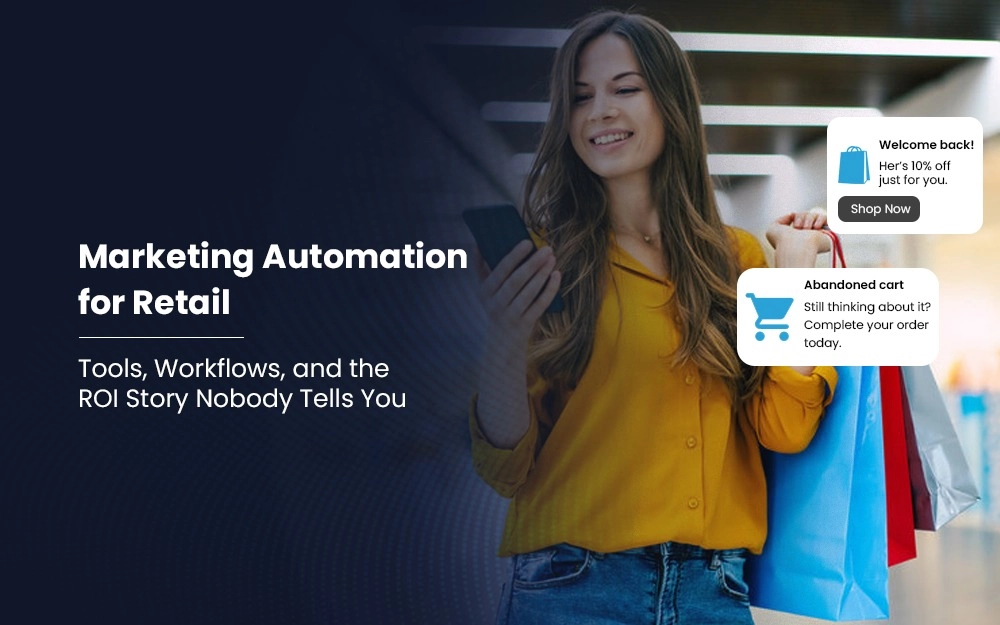
Another customer browses the app, adds a pair of shoes to her cart, and then life pulls her away. A few hours later, a push notification shows up reminding her — not an email, specifically a push, because that’s the channel her behaviour signals she actually responds to. This is the abandoned cart recovery flow, and it’s consistently one of the highest-return automations in retail — not because of clever copy, but because the person already wanted to buy. They just got distracted. The message catches them at the right moment on the right surface.
Then there’s the loyalty nudge — which is honestly underrated. A customer who’s 200 points from the next tier gets a personalised message: “you’re close, here’s a small boost.” That message only works because the platform knows their actual current points balance, in real time. A generic email tool without loyalty integration can’t do this. It can say “you have points” but not “you specifically have X points and here’s why that matters right now.”
And the festive sale itself? Instead of one blast to the entire database at 8 AM, the campaign runs in layers. Email goes out first. Anyone who doesn’t open it in four hours gets an SMS. App users who ignore both get a push notification in the evening. High-value members got a WhatsApp early-access message the night before. All of this was set up over a couple of days, tested, scheduled, and then left to run. The team spent sale day watching dashboards instead of hitting send.
The Segmentation Piece — where most of the intelligence lives
Automation handles the sending. Segmentation decides who. And this is where a lot of retail brands are still doing things the slow, manual way.
RFM segmentation — Recency, Frequency, Monetary — is not a new idea. It’s been around for decades. But most brands that use it run it as a once-a-quarter exercise in a spreadsheet, produce a few customer buckets, and then watch those buckets go stale for the next eleven weeks because nobody has the bandwidth to update them manually.
The value of automation here is that the segments update themselves. A customer who was dormant for four months makes a purchase — they shift groups automatically. Their next communication reflects where they actually are in their relationship with the brand, not where they were when someone last ran the analysis.
This matters more than it sounds. A “win-back” message sent to someone who bought three weeks ago isn’t just ineffective — it signals that the brand doesn’t know who they are. That’s the opposite of what you’re trying to build.
AI-powered segmentation takes this further. Rather than just grouping customers by historical patterns, it starts predicting — which offer is this customer likely to respond to, which channel will get through, what timing makes sense. It’s not magic. Vendors who sell it as magic are overselling. But even a decent ML model improves on gut-feel targeting at scale, and at 80,000+ customers, gut feel simply can’t scale anyway.
The honest answer on ROI
This section usually gets either vague or inflated. Here’s what’s actually true.
The clearest ROI is operational. Campaigns that used to consume two or three hours per segment become fast once the workflows are built. Across a full year of festive sales, product launches, tier milestones, birthday campaigns, reactivation pushes — the hours recovered are significant. And fewer errors: no more “wrong offer to the wrong customer” moments, no more duplicate messages, no more someone getting a “we miss you” email four days after a purchase.
The second ROI is relevance. Triggered, personalised messages open more and click more. Not because of some trick — because they’re actually relevant to the person receiving them. A loyalty nudge to someone genuinely close to a tier performs completely differently than a sale blast to the full list. The message is doing real work because the data behind it is doing real work.
What doesn’t deliver ROI: automation bolted onto messy, disconnected data. If your POS data and your app data and your loyalty system are three separate places with no unified customer view, the automation will faithfully execute bad logic at scale. Garbage in, garbage out — just faster. So part of the ROI conversation for any retail brand is also, honestly, a data hygiene conversation. One shouldn’t happen without the other.
Setup also takes real time — three to four weeks realistically, not three days. Mapping use cases, connecting data sources, building and testing workflows, then monitoring what actually happens in the first few live campaigns. Anyone selling a “live in 48 hours” setup is leaving something important out of that pitch.
Where Zence fits into this
When retail brands start evaluating automation platforms, the feature lists start blurring together after a while. Journey builder, omnichannel messaging, AI personalisation, segmentation, dashboards — some version of all of this appears on every product page.
What actually differentiates platforms for retail is how deeply they connect with loyalty and CRM data — because that’s where the retail-specific use cases live. Tier nudges, points-based personalisation, post-purchase follow-ups that reference the actual product category, win-back flows that know whether someone was a high-frequency buyer or a sale-only shopper. None of this works without that data connection. And a lot of capable email and SMS platforms simply don’t have it — they’re great at communication but disconnected from loyalty context.
Zence Marketing was built for exactly this. It’s not a generic automation platform that retail brands are trying to adapt, it’s built around the reality of how retail customers actually behave, across online and offline touchpoints.
A few things worth knowing specifically:
The Journey Builder lets you design exactly the kinds of workflows described above — welcome flows, abandoned cart recovery, festive campaign layering, reactivation sequences — across email, SMS, push, and WhatsApp. You can see the logic visually, which matters when your marketing team needs to edit a flow without calling in an engineer every time.
Intelligent Customer Segmentation uses AI and ML to group customers by actual behaviour and preferences, not static lists someone built six months ago. The segments update as behaviour changes. When a dormant customer comes back, they move. Their future communications reflect that.
Unified Omnichannel Presence means the same customer data drives every channel — so what someone does on the app is visible when triggering an SMS, and their loyalty status is accessible when building an email flow. Zence integrates 12+ touchpoints, which in practice means the platform covers the full range of how retail customers actually engage: email, mobile push, SMS and RCS, WhatsApp, web notifications, in-app messages, and more.
AI-Powered Personalisation goes beyond first names in subject lines. It adapts content and offers in real time based on what the customer has done recently — what they browsed, what they’ve bought, what tier they’re in, what they’ve responded to before.
And Dynamic Dashboards give the marketing team actual visibility into what’s working — not just open rates, but campaign-level performance against customer segments, so you know whether that loyalty nudge to the near-Gold segment is actually moving people up the tier, or just generating clicks that go nowhere.
For brands currently managing separate tools for email, loyalty, SMS, and reporting, the consolidation alone changes how fast the team can actually move. The unlock isn’t usually a single feature — it’s having everything connected in one place.
Things that come up in every conversation about this
“We already have an email tool. Why change?”
You might not need to change it. The real question is: can your current email tool access your loyalty data in real time? If the answer is no — and for most standalone email platforms, it is — then you’re capped on how personalised you can actually get, no matter how sophisticated the rest of the setup is.
“How long before results show up?”
Abandoned cart flows tend to show results quickly — within the first two weeks — because the intent is already there. Loyalty-based flows take longer because the segments need enough history to be meaningful. Plan for four to six weeks before drawing conclusions on those, and don’t kill a campaign after ten days because it hasn’t transformed revenue yet.
“We’re a smaller chain. Does this make sense for us?”
Yes, and sometimes the ROI percentage is higher at smaller scale because the starting baseline is lower. A retailer with 8,000 active customers still benefits from automated welcome series, cart recovery, and win-back campaigns. You don’t need a two-lakh database for the relevance benefit to show up. You just need connected data and a clear view of which use cases to build first.
“What about WhatsApp — is it actually worth the effort?”
In the Indian market, unambiguously yes. WhatsApp open rates for retail brands in India run significantly higher than email for most communication types, and it’s increasingly the channel where customers want to hear about loyalty rewards, flash sales, and early access. The key is using it judiciously — WhatsApp that feels spammy gets blocked fast, and there’s no coming back from that. Early access messages to high-value segments, tier achievement notifications, and post-purchase follow-ups tend to work well. Broad sale blasts to the full list usually don’t.
To wrap this up
Retail brands still doing this manually aren’t making a mistake, exactly. They’re just spending enormous amounts of time on things that a well-set-up system handles automatically — and quietly leaving money on the table by treating a two-lakh customer base like a single audience.
Marketing automation for retail is, at its core, about giving your marketing team time back. Time to think about what to say and to whom, instead of figuring out how to physically send it. Time to work on next quarter’s strategy instead of copy-pasting subject lines at 10 PM.
The festive-season Excel session doesn’t have to be a tradition.
If your brand is still managing email, SMS, loyalty, and reporting across separate platforms or if personalisation in your team still mostly means a first name in the subject line — it’s worth understanding what a connected platform like Zence Marketing Automation can actually do. Not as a pitch. As a genuine next step.
Book a demo with the Zence team and see it working on your actual customer data.